

Report error
We recently launched our website - help us to improve it!
Please fill in our error report.
Report errorArt from the construction period
Check it out: Lead glass picture
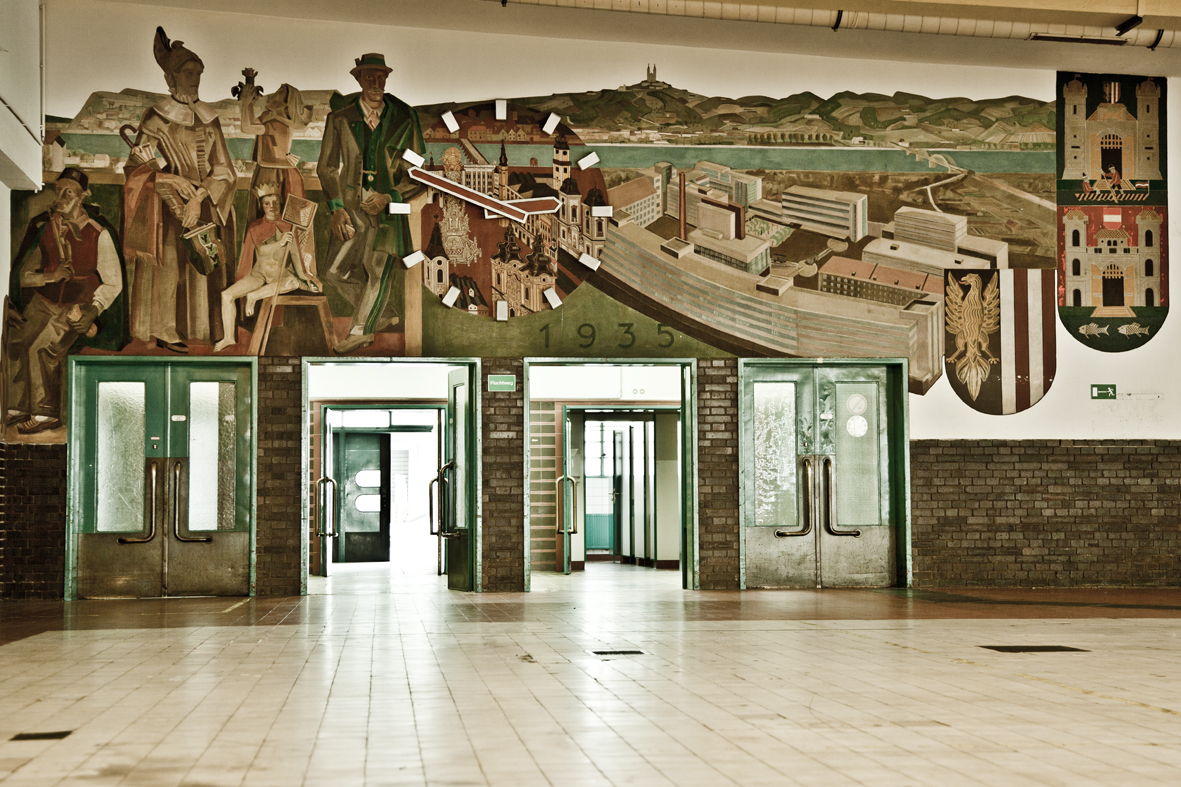
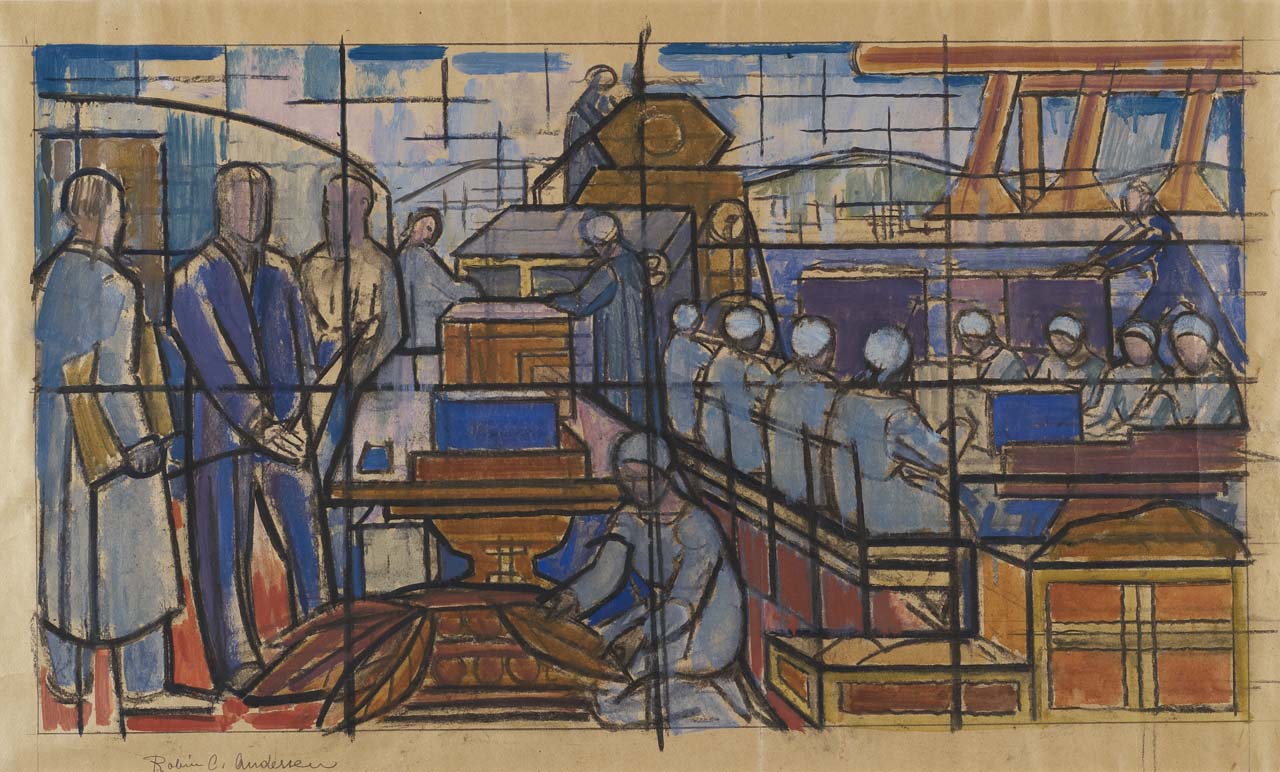
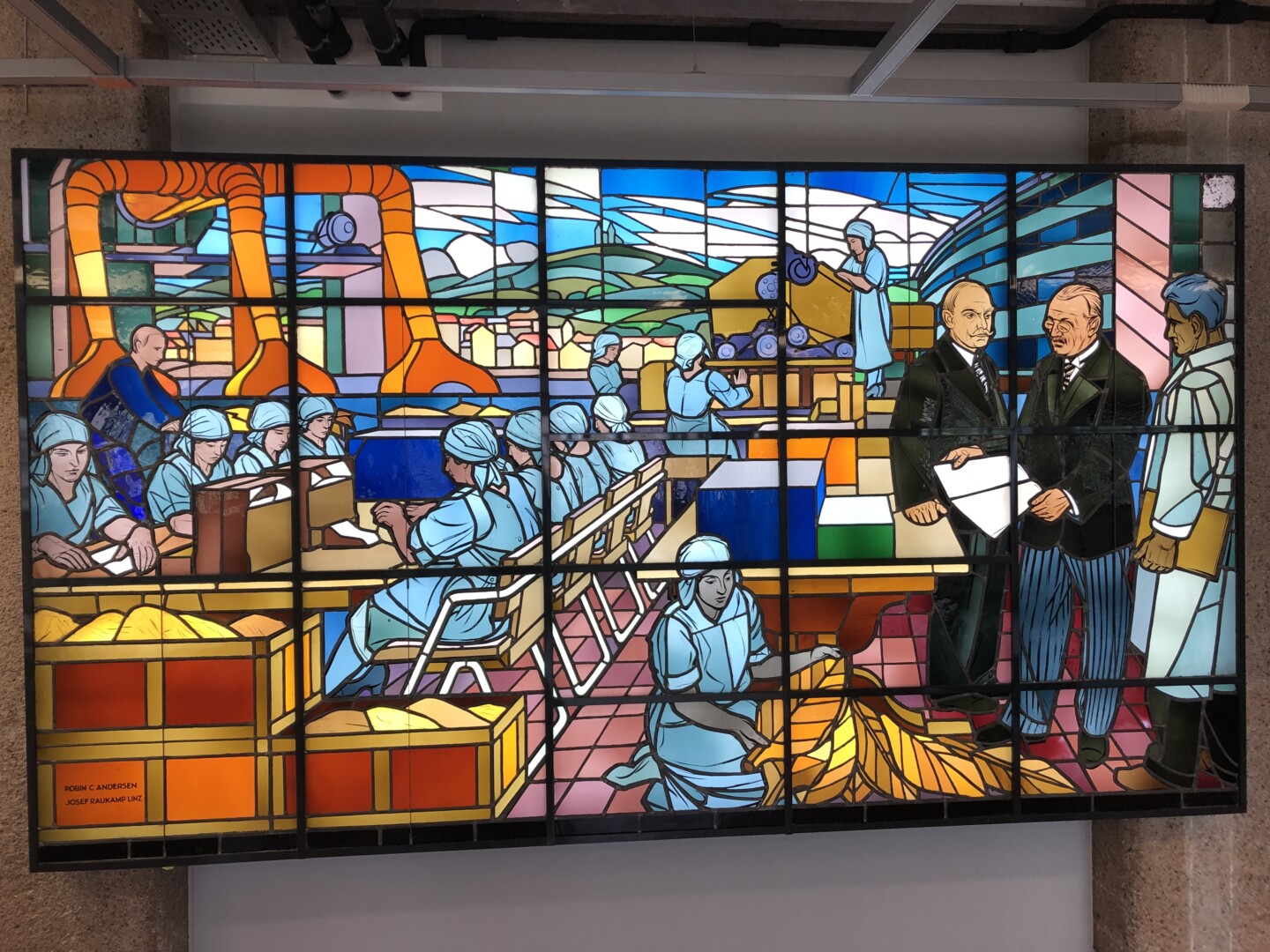
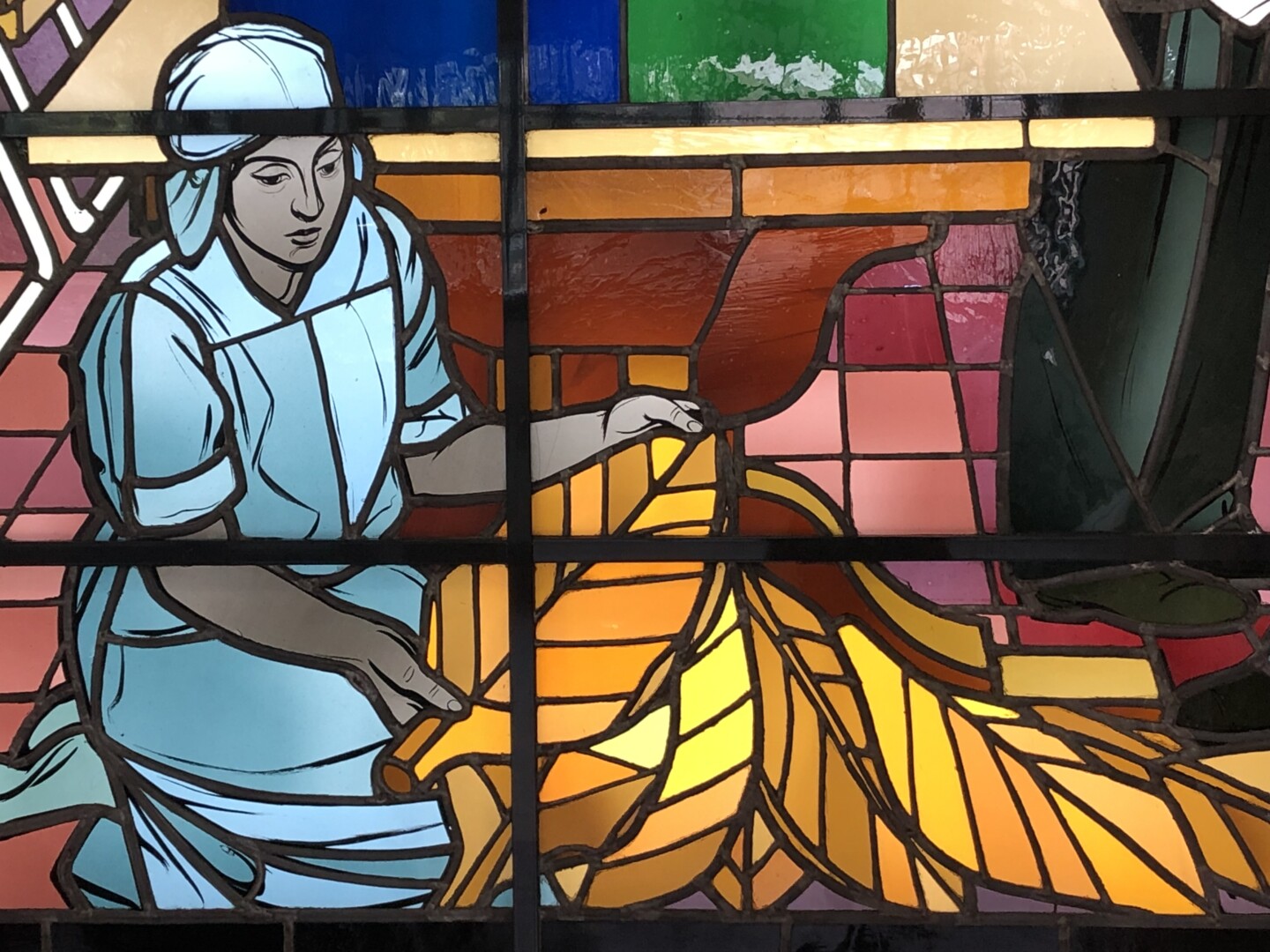
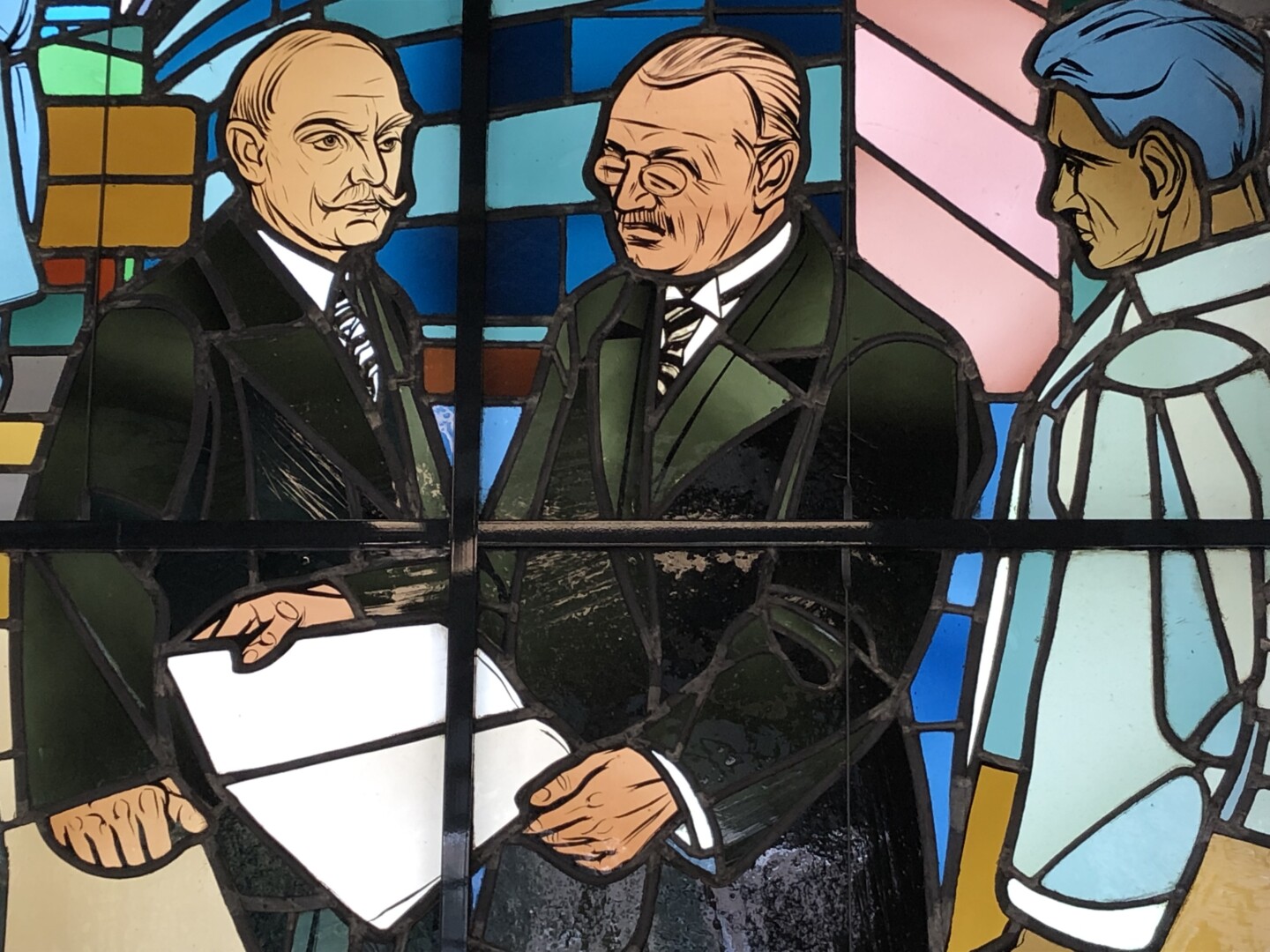
Josef Raukamp and Robin Christian Andersen, members of the Secession and co-founders of the Vienna Tapestry Manufactory, were entrusted with the craftsmanship of the glass artwork. The design is dated 1929. It was realized in the early 1930s.
It shows everyday scenes from pipe tobacco production at Tabakfabrik Linz. In the foreground on the right, it shows the Tabakfabrik’s architect, Peter Behrens, in conversation with the General Director of the Austrian Tobacco Directorate, Section Head Karl Dorrek. In the background, the scene is framed by Linz’s Pöstlingberg and the slightly curved façade of Building 1/Haus CASABLANCA. Next to it, workers inspect the tobacco leaves and turn them into pipe tobacco.
Nordico Stadtmuseum Linz
Tabakfabrik Linz
Tabakfabrik Linz
Tabakfabrik Linz
The Upper Austrian Stained Glass Workshop in Linz, now the Schlierbach Abbey stained glass workshop, produced the glass picture. A stained glass picture, which uses a much more sophisticated technique, should not be confused with a reverse stained glass picture. The colors of the glass picture are made up of individual colored glass blocks, whereas the colors of the reverse glass picture are simply painted on. The Tabakfabrik Linz artwork is made of hand-blown, genuine antique glass that has been cut, glued together and fired. The contours of the picture were painted with black solder, framed with hair lead profiles and executed using the lead glazing technique.
Originally, the glass picture hung at the main entrance to the pipe tobacco factory, today’s Haus DAMES. Later it adorned the administrative wing of the site. The glass picture found its permanent home in the CASABLANCA building in the Tabakfabrik Linz office – the building depicted in the picture itself.
Art after 1950
from left: Karl-Heinz Klopf & Gerhard Knogler “Zigarettenturm! 1982 | Photo: Gregor Graf 2010
Metal master class at the University of Art and Industrial Design, Linz “Flying Cigarettes” | Photo: Christian Schepe 2008
Erwin Reiter: Group of figures “Gardeners in Guantanamo” Soldier II and Dignified 2005/2006
Graffiti/Murals in the Feuergasse after 2009
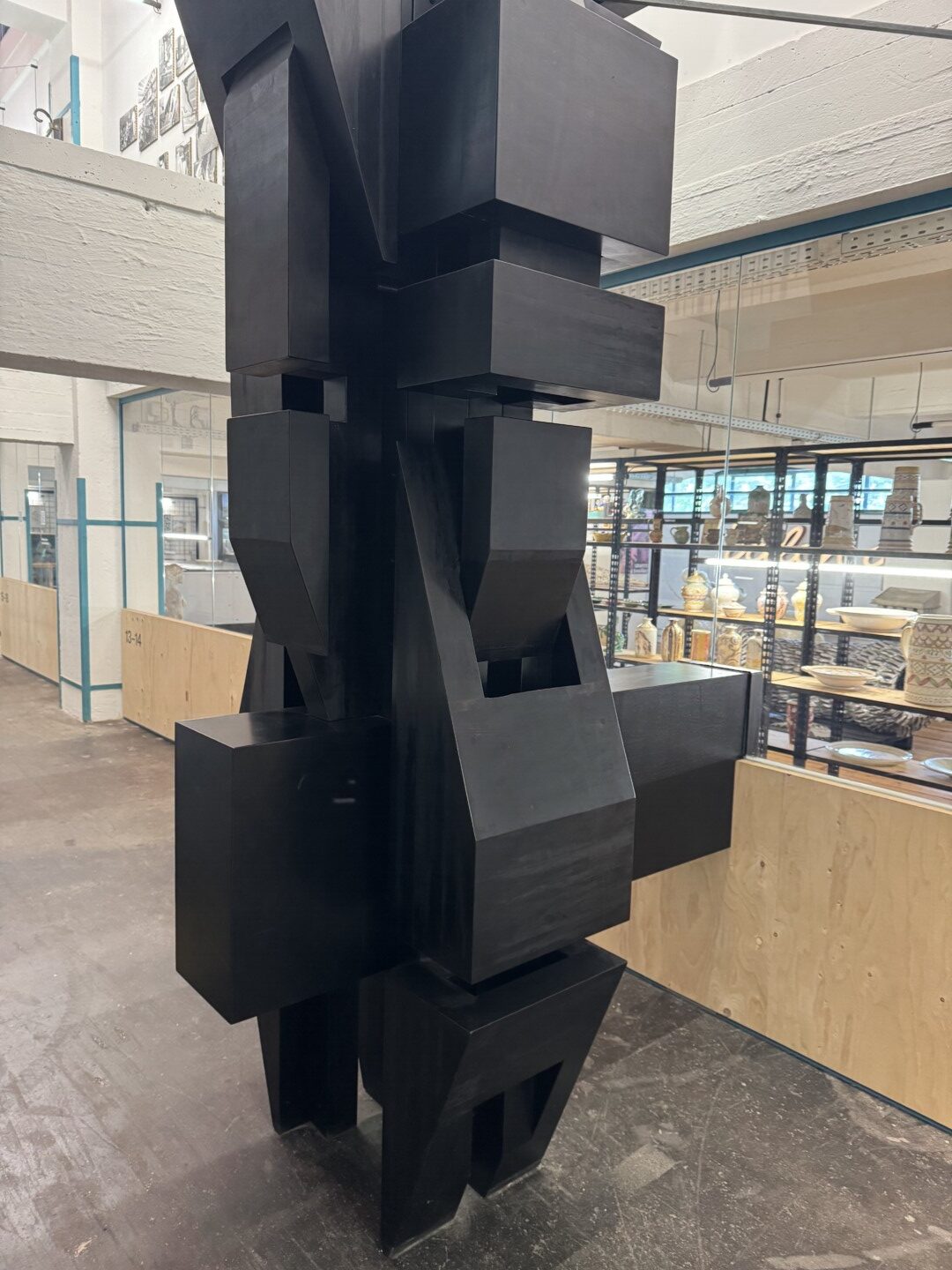
Helmuth Gsöllpointner: “Variable object”
Helmuth Gsöllpointner was an outstanding artist and designer who worked as a professor and rector of the Linz University of Art.
His remarkable work “Variable Object” was installed in the stairwell of the former Austria Tabak administration building in 1981/1982, during the expansion of the western area of the Tabakfabrik.
The former administration building was demolished when the Tabakfabrik was transformed in 2009. In close collaboration with the artist, we therefore chose a new, appropriate space for this work: the “Variable Object” has since been located on the second floor of the FALK building – a place where artists work actively and creatively.
Tabakfabrik Linz
Robert Oltay’s “Painted volume of stories” in the Lösehalle
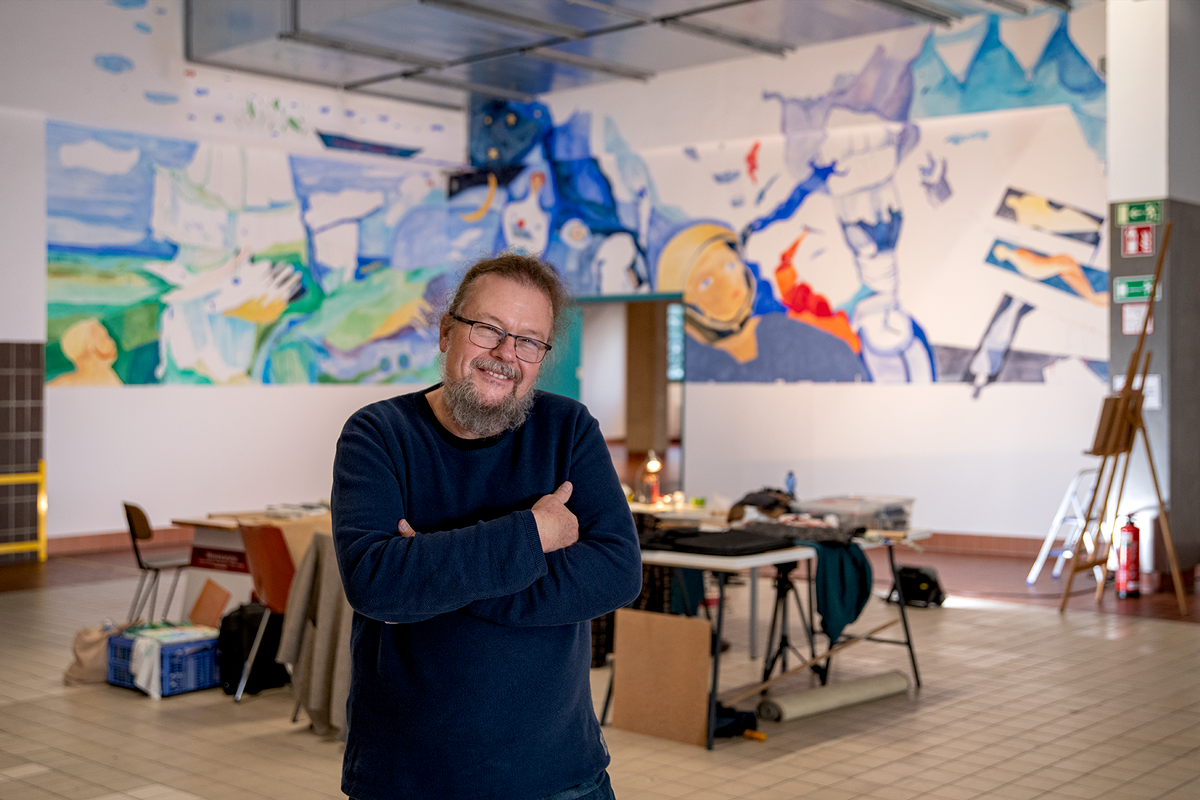
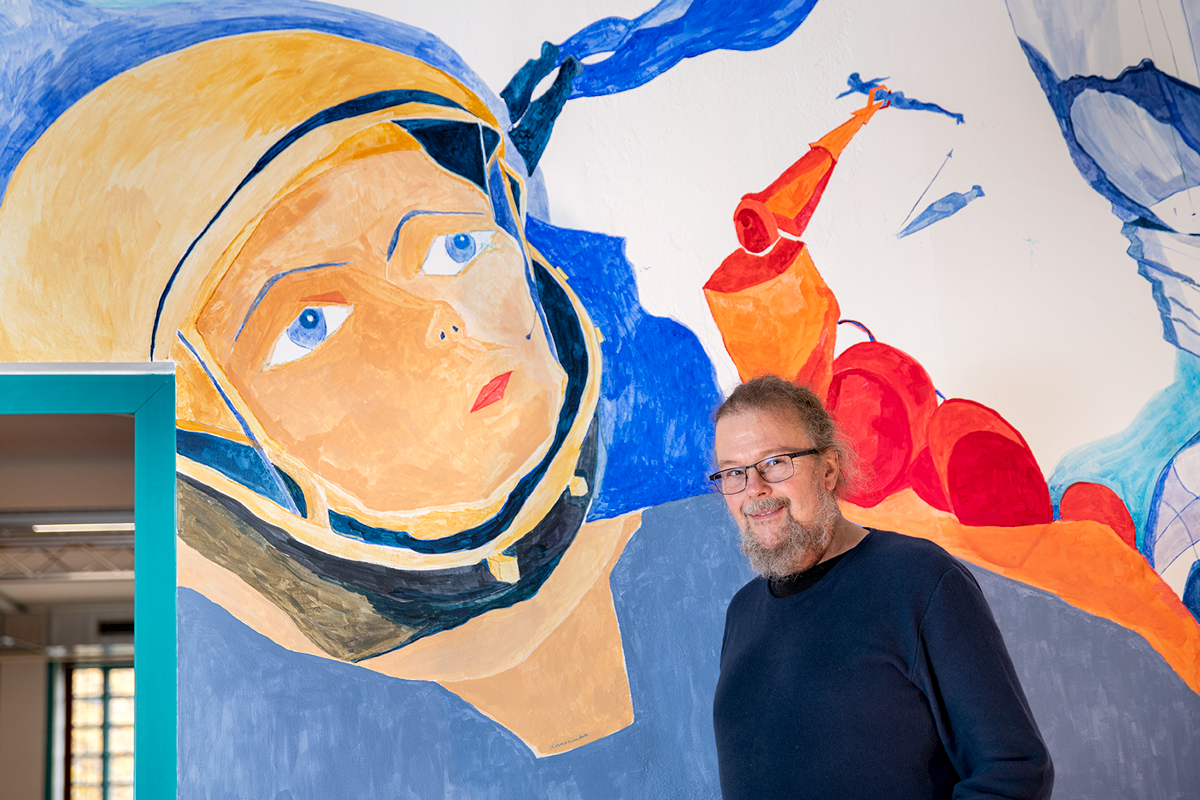
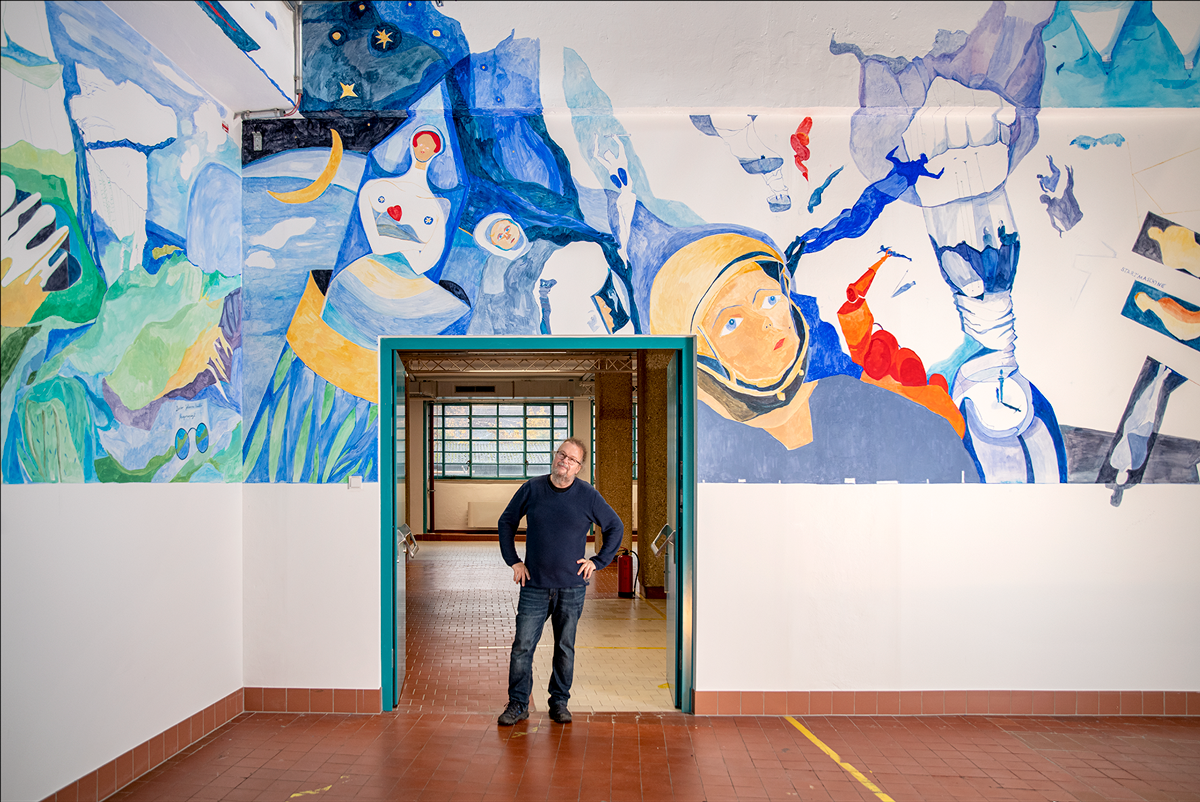
Linz painter Robert Oltay completed the second part of his mural in the Lösehalle at Tabakfabrik at the end of October 2020. Like a “Leonardo of Linz”, he depicted aspects of the present and future on an area of around 60 square meters.
28 days’ work, many hours on the lifting platform, several liters of acrylic paint and countless brushstrokes: Over the past few weeks, Robert Oltay has often been a lone worker in the vastness of the Lösehalle, where he has been able to express his very personal view of the next 100 years in the form of a twelve-meter-long and four-meter-high painterly “narrative volume”.
On the first 7.5 meters of wall space, the artist shows us how humanity could steer mankind and nature towards a balance with technical aids. The “starting machine” enables the continuation of the past (Herbert Dimmel mural) and the present (first part of Robert Oltay’s mural from the summer): People are catapulted like gallop racehorses by machine into the “racing area”, into the weightlessness of space, they swim in the air like divers and come close to the air-water machine in which these two vital elements are generated. Robotic arms help people to land.
In the episode, Oltay depicts the lunar, the cosmos and space travel, where a cosmonaut saves the world and meets the astronaut with “heart and stars in his soul”. Together, the couple glide past the moon into the ideal state of an intact world in which technology is only used smartly and therefore invisibly to us. The landscape has been given back what was once taken from it, humans and animals are in harmony.
Image credit: Violetta Wakolbinger
Violetta Wakolbinger
Violetta Wakolbinger
Violetta Wakolbinger
Robert Oltay, born in Aachen, Germany, worked in two stages over several weeks in the Lösehalle of the Tabakfabrik and had to incorporate structural features such as doors and ventilation shafts into his work. In early summer, Oltay created the first part of his mural, in which he dealt with pressing contemporary issues. He began the second part at the end of September.
“The Tabakfabrik has held a great attraction for me ever since I studied at the Kunsthochschule Linz. So I was all the more pleased to be able to paint in the Lösehalle. The space, capturing it and realizing it on a two-dimensional surface of this size was a great challenge,” says Robert Oltay.
ART MAGAZIN art association at Haus FALK
Kunstverein ART MAGAZIN and Haus FALK – a great collaboration.
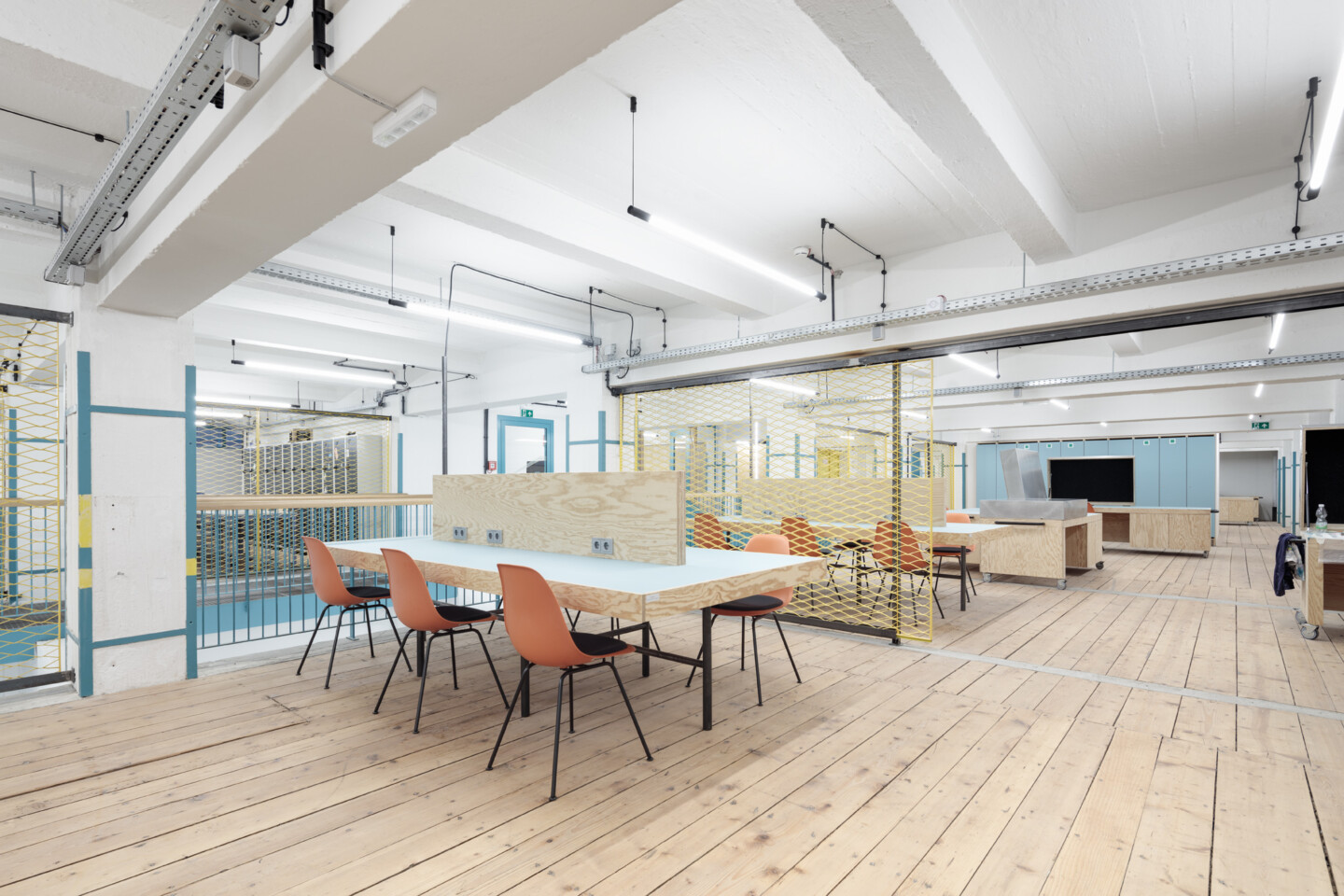
Where once the precious tobacco bales from the Orient were stored, artistic creativity is now being sparked. The FALK building at Tabakfabrik Linz on Untere Donaulände is home to various shared studios, an association-run co-working space, classrooms, art collections, workshops and individual studios.
Kurt Kuball
The art association ART MAGAZIN is located in Haus FALK. The association is currently working on its new website, which we will of course also publish here once it is completed. ART MAGAZIN members are often and gladly at home in the co-working space of Haus FALK (OG 3) or generally on the 3rd and 4th floors.
If you are interested, please drop by, there are often people to talk to and things to discuss at FALK.
Would you like to rent a desk or a studio at ART MAGAZIN? Contact us + 43 732 / 77 22 72 – 72 ansiedlung@tfl.linz.at
Show depot allows a look behind the scenes of the museums
Norbert Artner
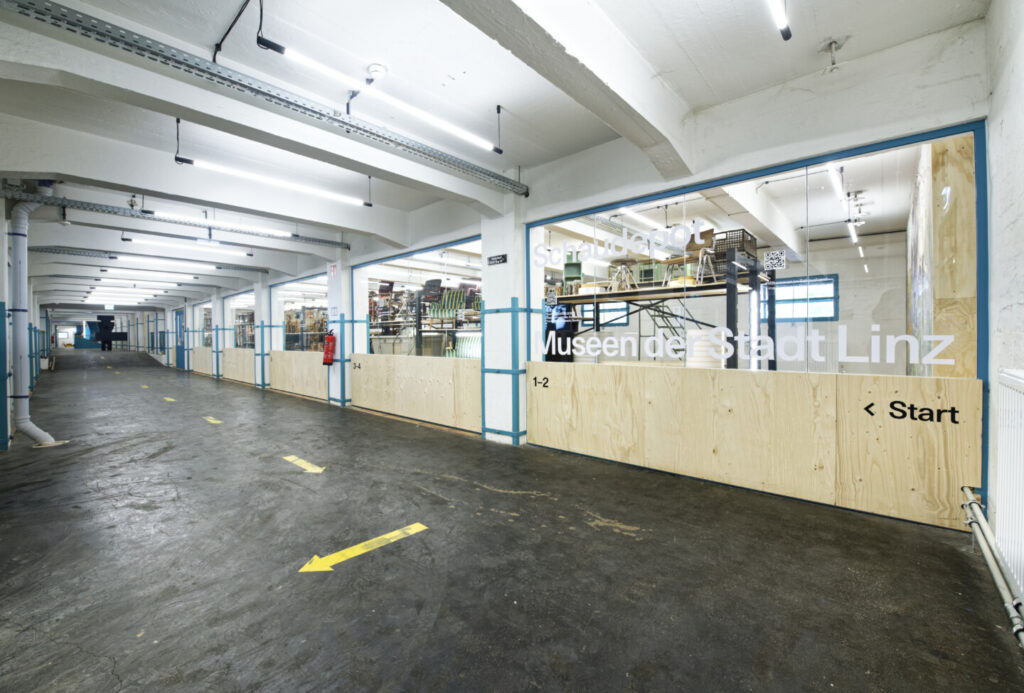
In 2022, the FALK building was converted into a cultural goods storage and display depot for the museums of the city of Linz (Nordico Stadtmuseum and Lentos). A depot situation that can be viewed by visitors along the Behrens strip offers a look behind the scenes of the museum’s work.
A total of 1,800m2 on the 1st and 2nd floors of Haus FALK, the former tobacco warehouse, were created in 2022 as storage space for the museums of the city of Linz. The publicly accessible display depot is located on level 1. Preservation and archiving in particular are often outside the public eye. The Schaudepot creates an awareness of what it means to manage the city’s art and cultural history collection. While the exhibitions at the Stadtmuseum are dedicated to new contexts and in-depth explorations of the city’s history, the Schaudepot, which is open to the public and located along the “Behrens Belt”, shows the serial wealth of the collection. With around 550 exhibits, it provides an exemplary insight into the collections of the museums of the city of Linz and reflects the organization of the entire depot. The dense diversity of these collections is shown on 360m2. Furniture, art, crafts, everyday life and industrial history are displayed on modular shelves that reflect the industrial character of the building. Equally important is the functionality of the depot. The museum’s storage facility is in constant use, which means that items must be easy to find and access. The display depot therefore changes depending on what is added or removed.
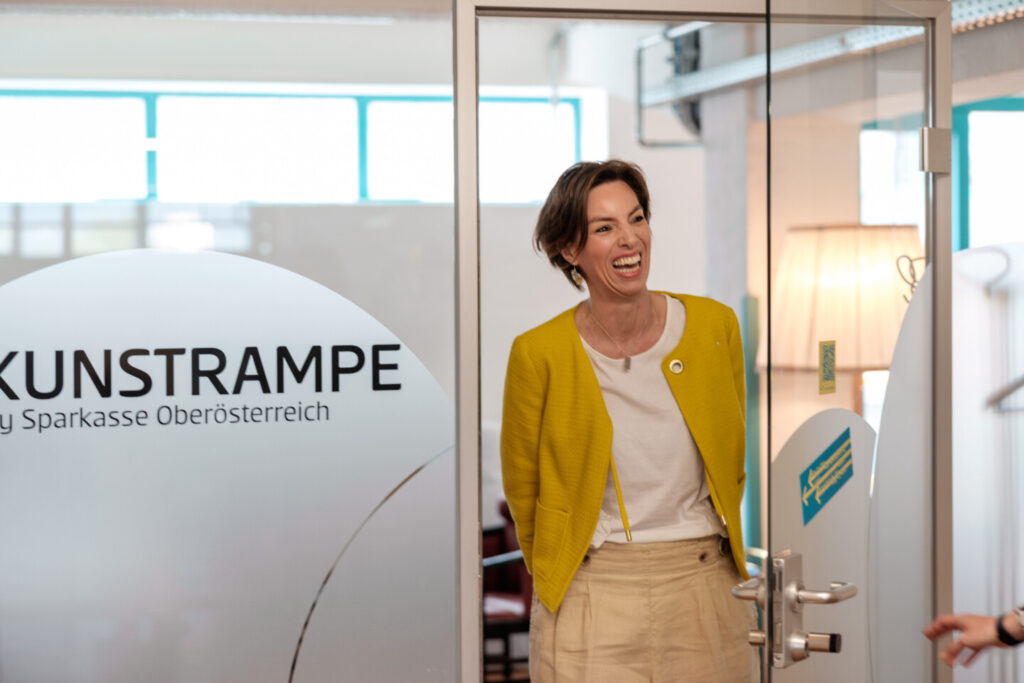
Art ramp by Sparkasse Oberösterreich
© vog.photo, All Rights Reserved
Sparkasse Oberösterreich has been a driving force in art and culture since 1849. With a corporate collection of more than 1,700 works, mainly by Upper Austrian artists of the 20th and 21st centuries, it sets a strong example. During the renovation of the head office, the art collection is housed in the Tabakfabrik, where Sparkasse Oberösterreich is a member of the Art Magazin association. Under the name Kunstrampe by Sparkasse OÖ, exhibition and mediation projects are prepared here and research into the company’s history is conducted. This diverse, open environment makes it possible to expand the network in the Linz art and culture scene and to initiate exciting collaborations and projects.