

Report error
We recently launched our website - help us to improve it!
Please fill in our error report.
Report errorThe ideas behind the relaunch
In 2009, the city of Linz bought the Tabakfabrik site. Where production once stood still, a unique ecosystem was to be created over the next few years. Tabakfabrik was to become an engine for new jobs, a magnet for talent and a symbol of Linz’s innovative strength.
The world of work is undergoing rapid change. Rigid hierarchies and isolated departments are giving way to flexible, networked structures. Buzzwords such as “New Work” and “Industry 4.0” are more than just trends – they describe a new reality in which creativity, collaboration and innovation are the most important resources. At Tabakfabrik Linz, this future has not only been imagined since the relaunch, but lived.
What does “Collaborative Corporation” mean?
Tabakfabrik was not conceived purely as an office location, but as a living organism – an “innovation ecology”, as the renowned Viennese research institute FAS.research called it. A dynamic innovation system requires twelve key rolse: from curious “explorers” and passionate “idealists” to creative “inventors” and experienced “mentors”.
This interaction between a wide variety of players – from one-person companies and startups to established companies and educational institutions – is intended to create an enormous dynamic of added value. Instead of competing with each other, tenants enrich each other, share knowledge and resources and create synergies that would be unthinkable in traditional structures. A study by FAS.research back in 2018 showed that all the key roles were represented at the site.
GERHARD GRUBER LINZ-AUSTRIA
Get to know the Tabakfabrik pioneers!
Basic theories
In the course of its reinvention, Tabakfabrik Linz explored the working world of the future. It was not only intended to be revolutionary from an architectural-historical perspective, but also to establish itself in the spirit of its creators Peter Behrens and Alexander Popp as a dynamic production facility, a testing ground for visions and for the concrete implementation of socio-political or socio-economic models for the future.
Systems theory creates leeway
The advantage of viewing the development of the Tabakfabrik as autopoietic lies in the realistic and innovative management and development strategy that results from this view. The traditional approach would be to view Tabakfabrik as an inanimate object at the mercy of outside intervention. A linear design process collects ideas, drafts plans and implements changes. In doing so, planners often assume that they know all the factors – this assumption is usually unrealistic. Learning processes, in which new experiences are made and recursively incorporated into the overall process through corrective interventions, are not envisaged. This harbors the risk of planning that ignores internal and external circumstances.
On the other hand, an approach inspired by systems theory recognizes that the actors – in their respective functions and areas – organize and develop according to their own specific logics, in the sense of subsystems within an overall system. Which relationships the actors enter into within the areas or between areas is left to the relative autonomy of the subsystems. This creates space for a variety of contingent alliances between all actors involved. This approach is much more realistic, as it recognizes the moment of contingency in all development processes. It incorporates corresponding phases of reflection and reorganization into the design process. A systems theory approach also makes use of the specific creative potential that arises when systems are given room for self-organization and the productive moment of contingency. The control of the overall system is not abandoned: On the one hand, it focuses on the implementation of political, economic and technical framework conditions to which the subsystems align themselves. On the other hand, it causes the controlling actors to perceive themselves as part of the overall system, which may hold a certain position of power, but in this position they are exposed to the mutual interactions and dependencies of the subsystems. This self-image generally conveys a socially trained, capable and reflexive management style.
Autopoiesis
Systems organize, develop and change within the framework of a special logic of their own. They require different elements for their structure and network themselves into different structures. The term “autopoiesis” is used when these elements and structures are produced and reproduced by the system itself. An autopoietic system creates and maintains itself from within. However, the concept of autopoiesis does not mean the renunciation of contact with the outside, with the environment. Interaction is important for the system, but it does not dictate the system. The system itself regulates the extent and form of dependence or independence from its environment. In this sense, the system retains its relative autonomy, acts on the basis of its own logic and is therefore not arbitrarily controllable from the outside.
The concept of “contingency” is central to the structure of social systems. In the relationships with the environment and in the internal relationships between the elements, exists the phenomenon that only a few relationships, rather than all possible ones, ever come about and shape the system. The relationships between the elements do not follow any fixed rules; there are neither necessary nor impossible connections: They are contingent. The result is that systems with similar determining elements nevertheless organize themselves very differently.
Linz 4020
The concept 4020 Linz – Tabakfabrik 2040: Strategy for the further development of Tabakfabrik Linz names four pillars as the basic elements of the new district: Creativity, Social, Work and Education. These elements form a structural guideline for the development of Tabakfabrik’s content; in addition, there is a contemporary understanding of public space. This term does not refer to a publicly subsidized space, but is aimed at the dynamics of the appropriation of this space for social, cultural and political purposes. The concept of public space itself becomes a question of development and differentiation in the overall process.
The main actors in this concept are the political representatives and the management of Tabakfabrik, but the four areas of activity are also involved in its development. From a systems theory perspective, all actors – political representatives, management and pioneers – form subsystems of an overall system and develop relatively autonomously.
The terms “co-working” and “community production” focus on collaborative working structures that enable effective local and international synergies and promote small-scale, decentralized production by providing high-tech infrastructures and sharing resources. Cooperation instead of competition should determine everyday life.
New working environments
Tabakfabrik has always been concerned not only with the present, but also with developing concepts for the year 2040, when the population of the city of Linz could have doubled. People’s lives will follow new rules. For example, the labor market will develop more in the direction of the new independence. While the high degree of individual autonomy in the organization of work is seen as positive by many, this is often paid for with high financial risks and chronic competitive pressure. Tabakfabrik wanted to consciously counteract these negative developments. Inspired by the ideas and concepts of the think tank NANK (New Work – New Culture) based on the social philosopher and founder of the so-called New Work movement Frithjof Bergmann, new professional milieus for creative micro-enterprises have been created and tested since 2010.
The terms “co-working” and “community production” focus on collaborative working structures that enable effective local and international synergies and promote small-scale, decentralized production by providing high-tech infrastructures and sharing resources. Cooperation instead of competition should determine everyday life.
The production chain: from the idea to the finished product
At the heart of the Collaborative Corporation’s concept is a well thought-out production chain that physically runs through the site. It follows the path of an idea from its inception to market maturity and is divided into three areas:
Knowledge Unit (Contentik)
It is here, in the fields of art, research and education, that the decisive impulses arise. Institutions such as the University of Art and Design Linz or Gerhard Haderer’s School of Disobedience (2017-2020) are the driving forces behind new approaches.
Design Unit (Creatik)
In co-working spaces, studios and agencies, the creative industries are picking up on the impetus of content. Startups and designers are developing concrete designs and concepts from abstract ideas.
Maker Unit (Protopik)
In neo-industrial workshops such as the GRAND GARAGE, the design becomes a tangible prototype. Open high-tech workshops with 3D printers, laser cutters and CNC milling machines make it possible to realize ideas quickly and professionally.
Promotion of the creative industries
Tabakfabrik Linz was established as a hub for the creative industries and a center for digitalization. Today, individual entrepreneurs and organizations from the fields of architecture, design, arts and crafts, media and advertising produce on site. By specifically promoting this growth industry and bundling it locally, Linz wanted to catch up with an international trend after the purchase of Tabakfabrik, as value creation and employment in the creative industries rose continuously in the 2010s despite all the economic crises. For this reason, the Creative Region Linz & Upper Austria networking platform was established in the Tabakfabrik at an early stage.
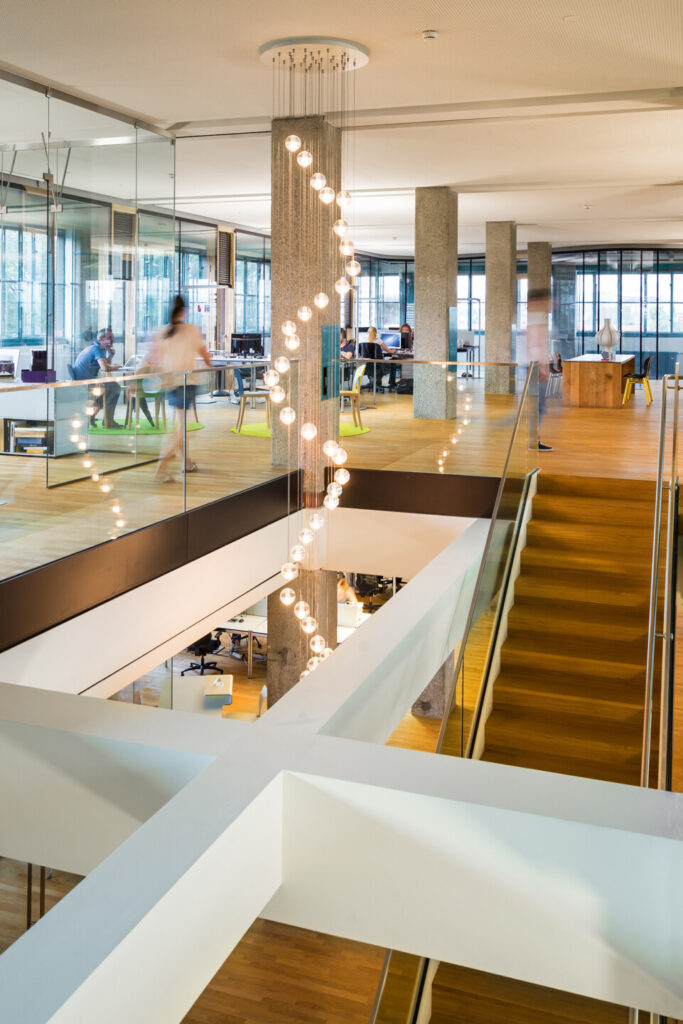
Spaces that promote collaboration
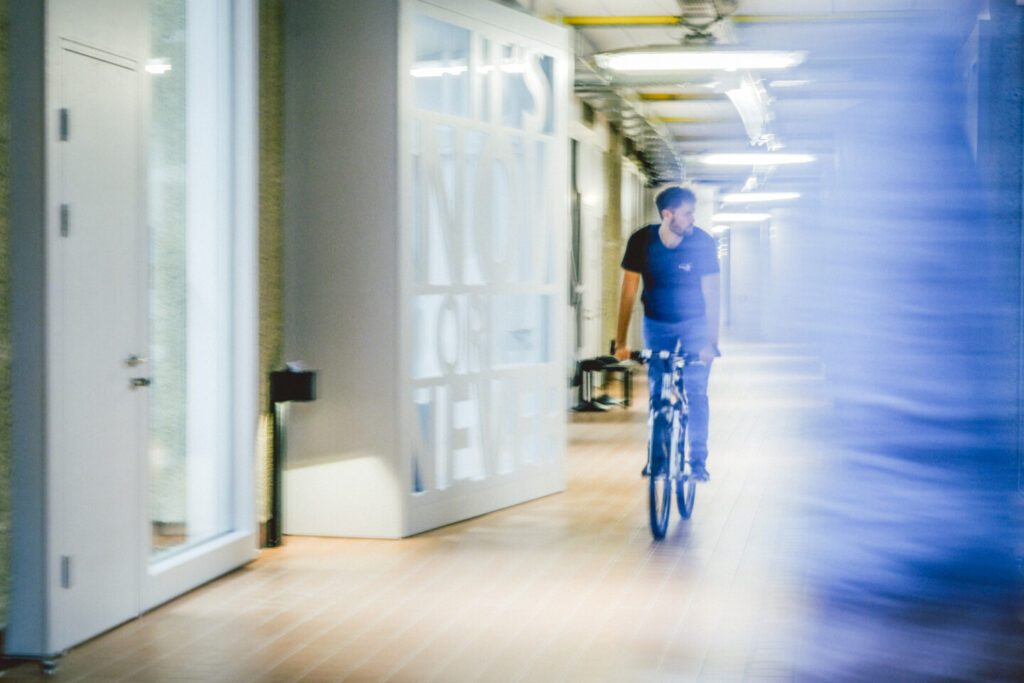
The concept also manifests itself in the architecture and infrastructure. The Strada del Startup, a 230-metre-long indoor promenade in the CASABLANCA building, is a production line for juvenile companies that is unique in Europe. It not only offers flexible office and workshop space, but also an “all-round carefree package” with access to mentors, investors and a lively community.
As a huge makerspace, the GRAND GARAGE closes the gap between digital design and physical product. It is the “missing link” that enables inventors, creatives and companies to realize their visions directly on site.
Netural / Sighart, Fehkührer
A Bauhaus 4.0 for Linz
Network analyst Dr. Harald Katzmair described Tabakfabrik 2018 as “one of the most exciting and relevant future projects in Austria” and compared its role to that of the historic Bauhaus – a “Bauhaus 4.0”, where not only work is to be done, but the future of work itself is to be rethought and redesigned.
The Tabakfabrik Collaborative Corporation is therefore more than the sum of its parts. It is a promise for the future, a place where the power of community gives rise to innovations that radiate far beyond the borders of Linz.